
How I Learned to Speak Dutch

After a couple of weak attempts, I finally learned to speak Dutch over a 10-month period that took me from A0 speaking level in September 2023 to successfully passing the Staatsexamen Nt2, Program I (B1 level) in July 2024. I did this with less than 60 hours of active studying, without ever having lived in the Netherlands, and without actually dedicating much time at all to the effort. I followed a passive learning approach that I developed myself out of necessity. I was very busy with family, work, sports, household chores and life in general, and had no time or energy for studying a language. So, I decided to see if I could learn Dutch without studying. And to my surprise, it worked.
You might be suspicious of my claim that I dedicated almost no time to the effort. The key word is “dedicated”. During these 10 months I spent hundreds of hours listening to Dutch while doing other things. I was multitasking. I enjoy endurance sports, which gave me 10 to 20 hours a week that I could spend listening to Dutch content. I listened to Dutch every chance I got: driving, doing household chores, walking the dog, falling asleep. I shoved it into every five-minute crack in my life. There was of course a cost: I had to stop listening to or scrolling through content in English on my phone. Everything had to be in Dutch. I created a Dutch-language playlist on Spotify, watched Dutch programs on YouTube, subscribed to Dutch podcasts, and most importantly, listened to over 50 Dutch audiobooks.
The first audiobook that I purchased was 2000 Most Common Dutch Words in Context: Get Fluent & Increase Your Dutch Vocabulary with 2000 Dutch Phrases by Lingo Mastery. I have vivid memories of listening to this book while hiking in the foothills of Salt Lake City. It’s a boring, monotonous book, but so is hiking for exercise, right? I listened to it from start to finish three or four times, and I could feel it working. I was actually retaining the Dutch words. Next I bought Easy Dutch Phrase Book, Conversational Dutch Dialogues and Dutch Short Stories for Beginners, all also by Lingo Mastery. The latter was my favorite of the bunch. It contains a great short story about four Dutch students who go on a weekend trip to Ameland, lose their keys, and have to break into their own apartment when they get home. This story was a revelation. For the first time in my life, I felt transported and entertained by something written in Dutch.
Unfortunately, there were no more books from Lingo Mastery available, otherwise I might have listened to 10 more. Thus, after trying a couple of other books for Dutch language learners that there were really bad, I transitioned to real Dutch audiobooks, starting with the Vos en Haas children’s series by Sylvia Vanden Heede. These did not have English translations following the Dutch content. The language in these books is pretty easy, but I was constantly stopping and looking up words on Google Translate that I didn’t know. It was annoying but there was no alternative. I made a deal with myself that I would ignore words that weren’t crucial to understanding the stories, but unfortunately most of them were. Worst of all, my audio-first approach meant that I was hopeless at Dutch spelling, making each lookup a total ordeal.
About this time I started watching Dutch YouTube videos (with subtitles also in Dutch) for about an hour or so each night. Some of these, such as the Dutchies to be channel, involved actively learning grammar, so I count these hours toward my 60-hour active-learning total. However, I was usually just half-watching whatever beginner material I found to be both easy and entertaining, like the Heb je zin? animated soap opera and Dutch Today. I am a morning person and have a demanding job as a software engineer, so I wasn’t up for much. Nevertheless, I learned quite a bit of grammar and spelling from these shows without ever feeling like I was making much of an effort. To support Dutchies to be creator Kim Jautze I bought her Dutch for higher-intermediates course, but I never read it. It’s probably a great course, but by this point I was spoiled for traditional language learning methods. I was pretty sure I wouldn’t need them.
I learned about the Dutch Today podcast from the YouTube channel of the same name. I still listen to it and support Martijn Kluit via his Patreon. Another great podcast for learners is Zeg het in het Nederlands. And later, as I improved to B1 level, I listened to dozens of the true-life stories from Echt Gebeurd. But my bread-and-butter remained audiobooks. I have purchased exactly 40 Dutch audiobooks on Luisterrijk, and have listened to 10 or 20 more on Spotify and Audible. After graduating from Vos en Haas, I discovered Anna Woltz, whose short novels for 9 to 12-year olds were absolutely perfect for me. I rarely had to look up vocabulary words any more, meaning only once about every 10 minutes! By this time it was early winter and my exercise changed to long ski tours. I listened to all of Anna Woltz’s books with skis on my feet. By late winter I was listening to romantic comedies, which are great for contemporary settings and vocabulary. A bit late, I finally found my all-time favorite Dutch learner’s audiobook, Nieuw in Rotterdam by Max Koedood, which is free to listen to on Spotify, with a print version that you can buy. I’ve listened to it three times and have also bought the unfinished sequel, Thuis in Rotterdam.
I also needed music in my life of course, but I made sure it was Dutch. Something that was well known to every human before the printing press is that words set to music are much, much easier to remember. It’s the basis of the advertising jingle: Your brain just won’t let go of a catchy phrase set to music. After a few months of listening to Dutch music I had dozens of these set phrases burned into my mind. Unlike sentences from a book, which I could not confidently repeat even an hour later, my recall for these lyrics was rock-solid. That was a huge confidence builder, and led to my first attempts to speak in Dutch. It’s pretty hilarious that my first sentences in Dutch were song lyrics like Zie ik je later aan het ontbijt? (Monique Smit, Blijf Je Vanavond), Hier sturen we tikkies van 50 cent (Donnie, Marco Schuitmaker, Hier Mag Alles) and of course, Praat Nederlands met me (Kenny B, Parijs).
At this point I need to confess a couple of things. First, I learned German in school and speak it pretty well, which helped a ton with Dutch grammar. Second, my wife is Dutch. Aha, you laugh, that explains everything! Not really. We have always lived in the United States, and for our entire relationship we have always spoken English. Her English is amazing and her impatience with bad Dutch is equally legendary. I’m sure many English-speaking people with a Dutch partner know exactly what I’m talking about. It even seems to be true for those living in the Netherlands. As described in The Dutch paradox by Marjan Ippel:
Even the non-native speakers’ spouses decline to speak Dutch. Speaking English is simply faster, and speed is apparently always of the essence. Also in love. Even in love. Some students come up with creative solutions, like the Swedish Kitte: “When me and my boyfriend walk the dog together, we always speak Dutch.” That sounds very promising to the group. “Which comes down to once a week at the most”, she grins.
Although my wife found some of my out-of-context song lyrics outright baffling, she did warm up to my attempts to say sweet things in Dutch pretty quickly. Keep in mind that I only attempted to speak after listening to literally hundreds of hours of Dutch. In keeping with my passive, lazy approach, I certainly didn’t rush it. Early in the listening effort I asked her why it was that I was starting to understand the beginner short stories fairly well, but I still couldn’t get any Dutch words to come out of my mouth. Her answer was insightful, direct and accurate: “Because there are so many words in Dutch. And you don’t know them.”
Although speaking wasn’t yet working, we did start watching Dutch TV shows together on YouTube and the NPO Start app. Two of our favorites were the FOMO Show and Boer zoekt vrouw. My wife would always end up commenting on the shows in Dutch, and I would try to join in. When it became clear that despite the Dutch subtitles I still I didn’t understand something important, she would then explain it to me in English, which was also handy. Apart from these at-home date nights, I also watched some Dutch current-events channels on YouTube like Lubach and the surprisingly cool NOS Jeugdjournaal, but I didn’t really have a whole lot of time for watching TV.
As I slowly began to speak, it was always the set phrases from lyrics and spoken language that powered my progress. Engineers know that the key to efficiency in building new things is to compose them as much as possible from pre-existing components. Set phrases (phraseme) are the building-blocks of spoken language, encapsulating both vocabulary and grammar in neat little packages. I realized eventually that the decomposition of vocabulary and grammar into separate categories in traditional language instruction is great for mastery, since in theory you will eventually be able to build anything you want by combining lists of unrelated words with grammar, but it’s a long road to get there. And it overlooks the innate ability of the human mind to improvise based on pattern matching. Once you have internalized a large body of set phrases, your mind distills the shared patterns into an unconscious understanding of grammar. I’m not a scientist and this observation is just based on my own personal experience, but I’m pretty confident about it. I feel like there must be some parallels between the approach I took with my many hundreds of hours of listening to Dutch, and the power of scale in machine learning. But I digress. (”But I digress” is a nifty example of set phrase.)
Around March 2024, as listening to Dutch became easier and easier, I knew I was in danger of getting stuck on a plateau. We were planning an epic, month-long vacation to the Netherlands for July 2024, and I wanted to make the most of it. Previously, I had only visited the Netherlands four times, each time for only a week, and of course I never learned any Dutch on these trips. The Dutch YouTube channels I watched sometimes discussed preparation for Inburgering and Staatsexamen Nt2, which are Dutch government-administered language tests for immigrants. I checked the calendar, and one of the Staatsexamen dates was during the first week of our trip. I knew I would be busy with work right up until the trip, and wouldn’t have the benefit of being able to study for the exam while on vacation, but I decided to register for it anyway. I thought I was probably already at A2 level in listening and reading, so I chose the B1 exam as a stretch goal. It was a great decision and I immediately began thinking much more critically about my Dutch skills. Improving my extremely limited speaking ability was obviously the top priority, but I was also concerned about writing, especially spelling.
After attempting a practice speaking exam online, and not being able to utter a word in response to the questions, I realized I really needed help. I looked on italki and found Job den Besten, a Dutch tutor specializing in the exams. I think I did five 30-minute lessons with Job, and they were invaluable. He is a total pro, and knew exactly how to coach me on how to think up simple, safe answers for the exam questions, most of which were oriented around day-to-day work scenarios, such as working at a checkout register or in a school. Unfortunately I was just way too busy at work to do more lessons with Job, but I managed to continue the active approach I learned from him on my own using the Google Gemini chatbot. I was typing in Dutch instead of speaking, which was not ideal, but it worked. I count the hours with Job and Google Gemini, along with watching the Dutchies to be grammar videos, as the bulk of my total of less than 60 hours of active studying.
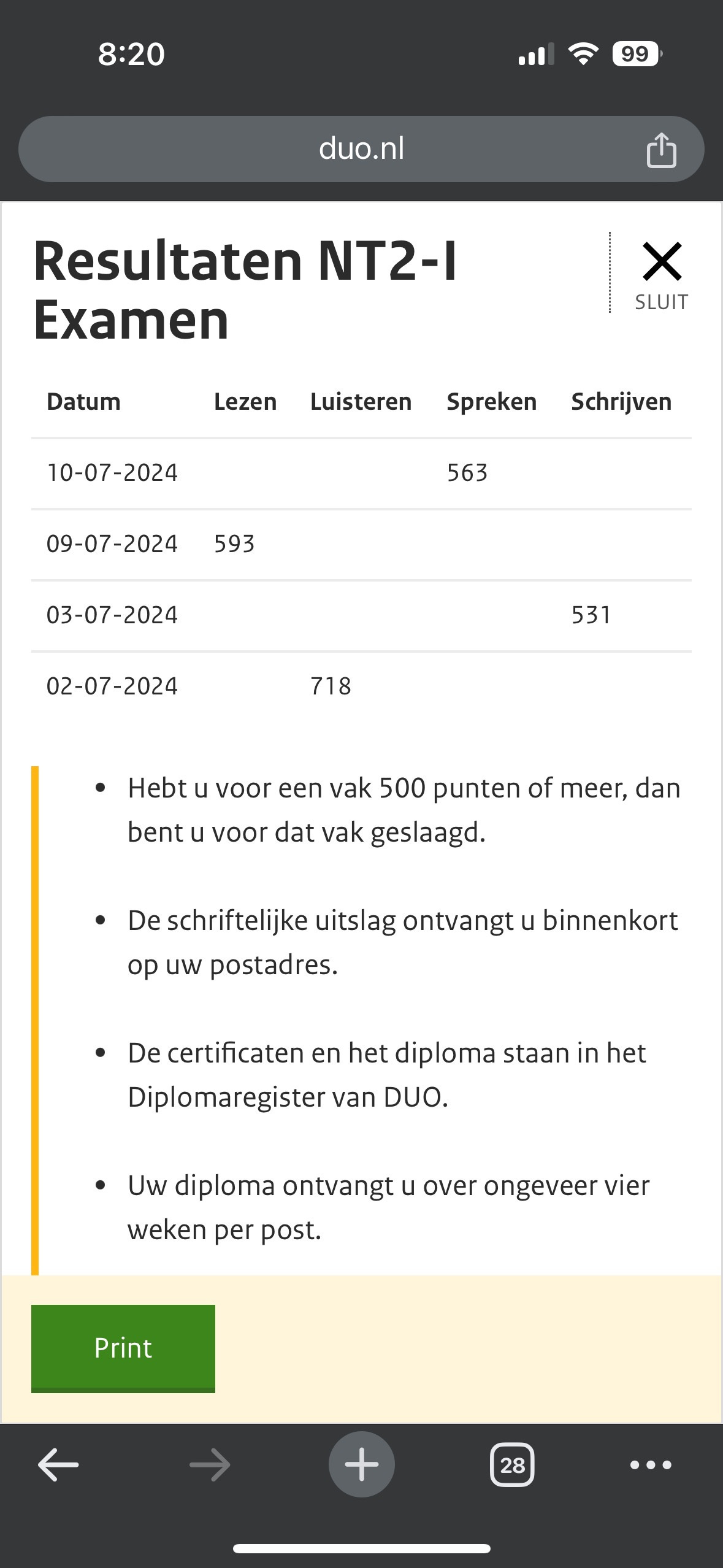
Amazingly, everything came together just in time for the exam. I spent four days of my precious vacation visiting a dour government exam center in Rijswijk. Some of you, dear readers, may know this place. It was a humbling glimpse into the lives of immigrants hoping to stay in the Netherlands, and quite the contrast from the scenic canal-side cafes and museums that I was used to. I’ll always appreciate having had this experience. A couple months later, back in Utah, a large white envelope arrived in the mail from the Netherlands. My B1 diploma was inside. The scores on everything except listening were just a few points above failing. I texted Job: Hakken over sloot, zei mijn vrouw.
The diploma was not the real prize of course. My wife had witnessed my painfully slow progress in speaking, and was therefore not too surprised that I could now really speak Dutch. But our Dutch friends, some of whom I have known for more than half my life, were absolutely in shock. They could not believe it. Speaking with them in Dutch, and with every other Dutch person I interacted with that month, was like living in a dream. I had broken through the Dutch paradox. Almost no one replied in English, and the one person who did soon gave up. It was just too awesome for words.
I’ve purchased the 2000 Common Dutch Words audiobook and have been trying to listen to it whenever I can. Let’s see if I can replicate your success. 🤞